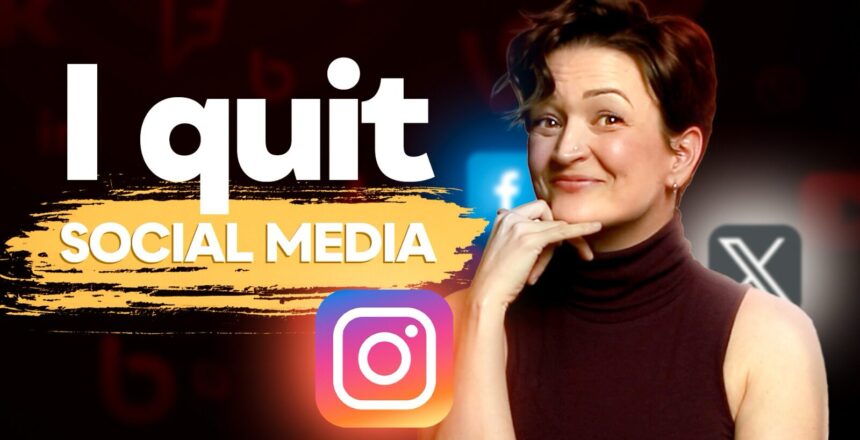
Three years ago, I made a bold decision: I quit social media—both personally and professionally.
But what followed surprised even me.
In this post, I’ll walk you through:
Why I left Instagram (and what I learned from quitting Twitter a decade earlier)
What happened to my business year by year after stepping away
What I’d do differently (and what you can learn from it)
How I’m now returning to social media—on my terms
👉 Prefer to watch instead of read? Click below to watch the Youtube video or keep scrolling for the full breakdown.
Why I Quit Social Media
Let’s rewind for a second.
Back in 2012, I walked away from Twitter. The platform felt like stepping into a crowded room where everyone was shouting over each other. And while the idea of connection was there, it just didn’t work for me—or my business. So I left. No regrets.
Fast forward to 2022, and I found myself doing the same thing on Instagram. Not because it was chaotic, but because it wasn’t working. I didn’t love the direction the platform was heading, and when I looked at my KPIs, I realized something wild:
Instagram wasn’t actually growing my business.
It was just eating up my time.
Meanwhile, YouTube was doing the opposite. Content I’d created years earlier was still generating leads, thanks to its creator-friendly algorithm and long-term search visibility.
So, I made a call:
Quit Instagram. Double down on YouTube.
Then came 2023… and long COVID.
What I Focused On Instead
When my health forced me to clear everything off my plate, I had to pivot fast. I turned my attention to:
Meta ads
A small-ticket funnel (my content course, A Year In A Day)
An evergreen webinar funnel, fueled by my existing SEO content
And it worked.
Even though I stopped producing new content, my old YouTube videos kept driving leads for nearly a year. I wasn’t spending time on social, and I wasn’t feeling overwhelmed. Instead, I was:
Enjoying the spaciousness of being offline
Feeling more connected, more grounded
Letting go of the noise, the pressure, the constant “on” of content
It was a brain reset—and I loved it.
What Happened to My Business (Year by Year)
Year One: The Honeymoon Phase
Despite my health setbacks, business was steady. Ads were performing. The evergreen funnel was converting. Old YouTube content still pulled its weight. I didn’t see any decline in growth or leads.
It honestly felt like magic.
Year Two: The Subtle Shift
Around the 12–24 month mark, I started noticing a few changes:
Fewer leads from YouTube (no new content = less recommendation)
Comments on ads asking if I was still in business 🤯
That one hit hard. It made me realize just how deeply people equate social media presence with legitimacy. Especially in a “trust recession” where anyone can call themselves a business coach, potential clients needed more ways to verify me.
So, I pivoted.
I led more with my credentials and client results. It helped… temporarily. But ad costs rose, and conversion rates dipped.
Year Three: The Wake-Up Call
By the third year, things plateaued:
My funnel was aging
My audience trust was dropping
And I’d lost touch with the market entirely
That’s when I really dug in. I did fresh market research. I listened to what my audience was being told (and sold). I upgraded everything—brand, messaging, strategy.
I even got my Accredited Small Business Consultant® credential.
And then… I tried to return to social.
The Hard Truth About Audience Decay
Coming back to Instagram was rough.
My 5,000 followers?
80% were either inactive or not even business owners anymore.
My YouTube subscribers?
Still there, but disengaged after years of silence.
I realized: Every year, your audience naturally churns. If you’re not actively growing, your numbers may look the same—but your real audience has shrunk.
Worse? The entire digital landscape had shifted:
SEO was evolving fast
AI and short-form video were dominating
Attention spans were shrinking
Trust was harder than ever to earn
And I had two choices:
Keep resisting… or find a way forward that didn’t burn me out.
What I’d Do Differently
Looking back, I wouldn’t change the fact that I quit social media. It helped my health, my mindset, and even my marketing (for a time).
But here’s what I would change:
Quit with a plan, not just a reaction
Keep an active trust-building presence somewhere (even minimal)
Don’t neglect market awareness—ever
Most importantly: I’d remember that audience growth is a constant process. You don’t notice attrition until you stop growing—and by then, it’s already a problem.
What You Can Learn From My Sabbatical
If you’re considering quitting (or scaling back) social media, ask yourself:
👉 Where do my ideal clients find me?
👉 Where do they validate me once they do?
If the answer isn’t social media, great! You can treat your platforms like a digital business card—just enough to prove legitimacy.
But if your audience does expect you to show up on social, you still have options:
A lighter, more casual presence
Fewer platforms, done well
Clear boundaries (like I now use)
Or strategic outsourcing to stay visible
Where I’m At Now
In 2025, I’ve been slowly reentering the content world—my way.
In fact, I’m currently testing a crazy experiment:
90+ posts per week across six platforms.
It’s temporary. It’s intense. And I’m doing it to:
Rebuild my audience
Test what actually works
And figure out how to help you do it in a sustainable way
Want to see the results? I’ll be sharing them next week.
Subscribe on YouTube so you don’t miss it.
Final Thoughts: You Still Make the Rules
Whether you stay or leave social media, just remember this:
You get to make the rules in your business.
But your market should help you shape those rules.
Don’t burn yourself out trying to keep up. And don’t ghost your audience without a strategy. Instead, build something intentional—something sustainable—and something you can love long term.
🎯 Ready for help building a business you actually love?
Join the waitlist for Breakthrough Boss®, where I help small business owners grow without the hustle or burnout.