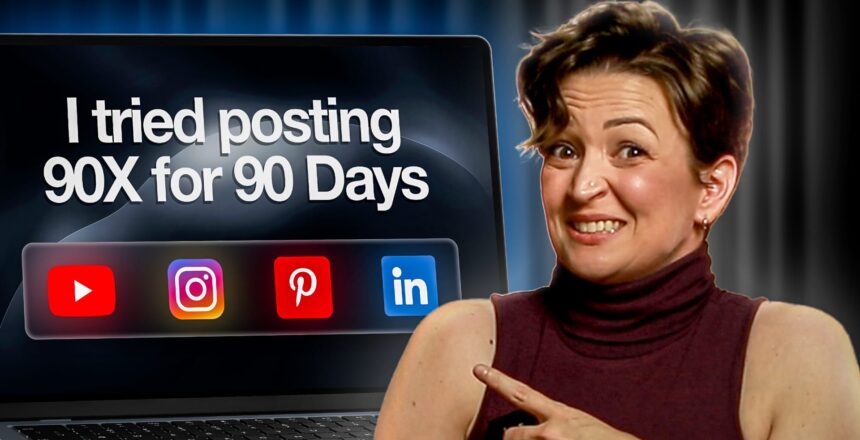
I ran a 3-month content sprint to answer a few big questions for myself and my clients. Could a tiny team produce both quantity and quality without burning out? How much time and money would it really take? Would the growth translate to revenue, or just vanity metrics? And most important: is it worth continuing?
👉 Prefer to watch? Click the video below.
Or keep reading for the full recap, numbers, and my new plan going forward.
The Experiment in a Nutshell
Scope: 90 posts a week for up to 90 days
Timeline: Intended June 2 through September, with strategy work beginning mid-April
Platforms: Instagram, YouTube, LinkedIn, Pinterest, my paid Breakthrough Boss community, and my free Skool community
Big Four Setup: Strategy, systems, tracking, and the content itself
I documented the entire plan in a live strategy doc and spreadsheet so I could track what worked, what flopped, and what to change. I went in open minded on metrics and set light targets since the goal was to learn, not to hit arbitrary numbers.
Strategy Highlights
Content goals: Teach, promote, and convert without pretending promotion and value are opposites. Most posts included both.
Cadence: Instagram was the heaviest lift. Long form on YouTube fed short form across platforms. Communities received regular, relevant posts.
Batching: I created three streams
Long form
Long form cascades like shorts, carousels, graphics, blogs
Fill-in content for gaps and timely ideas
If you want the granular details, hooks, and examples, grab the strategy doc.
Systems and Tools That Kept Us Moving
Team roles: I owned strategy, long-form planning and filming, carousels and graphics, captions, community posts, DMs, data reads, and adjustments. Editors handled video. My VA and a social media manager handled uploading, scheduling, and admin.
Tools: ClickUp, Google Workspace, ManyChat, RevTrack, Canva, and selective brainstorming with ChatGPT.
Note on AI: I used it for idea prompts, analogies, and light research. I wrote the content myself to keep the voice sharp and avoid clean-up time.
Scheduling: We switched mid-sprint to GoHighLevel’s social planner. Not perfect, but virtually free since I already use GHL for funnels, checkout, and messaging. It saved meaningful time and helped us avoid another subscription.
The Actual Posting Load
YouTube: 1 long-form video per week, plus 3 to 4 shorts from each
Instagram: 20 posts per week
Half reels or shorts, one quarter carousels, one quarter graphics
Four posts Monday through Thursday, two Friday, one each Saturday and Sunday
Communities: Free Skool and paid Breakthrough Boss, about 5 posts each per week
LinkedIn: About 5 posts per week
Pinterest: Targeted 10 pins per weekday, but this became the first thing to cut
Most content went out Monday through Friday to match how my audience consumes work-mode content and to preserve weekend boundaries.
Time Investment
My time per month, on average:
Long form planning 6 hours
Recording long form 4 hours
Writing video descriptions, emails, and extras 2 hours
Reels planning 1 to 2 half days
Reels recording 1 to 2 half days
Communities 1 hour total
LinkedIn repurposing 3 to 4 hours
Team time:
Editor time varied by video
My team spent roughly 2 to 3 hours per week on uploads, scheduling, and coordination
Social media manager handled overflow and organization
Real talk: 35 to 40 hours of my own time each month for content alone is heavy when you also run a business.
Costs
Monthly averages during the sprint:
Long-form editor: $300 per video
Short-form editor plus hook research: $750
IG strategist: $500 (annual retainer spread monthly)
ManyChat for IG: $15
Scheduler: GoHighLevel planner included in my existing plan
Social media manager: ~$1,000
Total monthly outlay: about $3,465, not including my time. Worth it for sanity and speed with a tiny team.
Results: Growth vs Revenue
Vanity metrics:
Instagram grew modestly, with much of the reach clearly coming from ads
YouTube subs and CTR did not pop during summer slow season
LinkedIn followers grew, but reach and profile views dropped when quality dipped under the posting load
Pinterest barely moved, and we ultimately cut it
Direct content revenue tracked:
About $8,000 from sponsorships
About $2,500 from content-driven sales we could attribute
The bigger win: how organic content supported paid media.
Cold prospects coming from Meta ads were warming up quickly when they found a strong grid of current content, then moved through email and into webinars. That lift turned a slow season into a solid one.
Cash collected in the period: $65,000, with more than double that sold on payment plans to be collected over the next 3 to 9 months. For June through August, historically my slowest season, that was a meaningful improvement.
Personal Impact
This pace had a cost. I manage chronic and genetic conditions. Higher stress increased symptoms like fatigue, pain, and brain fog. Boundaries are non-negotiable for me, and the sheer volume clashed with my values and energy. I want content that serves people, not the algorithm.
Mileage will vary, but do not underestimate the toll of volume for volume’s sake.
Is It Worth Continuing?
For me, not at this level. I am keeping the systems, but scaling to something sustainable that still looks robust from the outside.
My new plan:
YouTube: 2 long-form videos per month
Shorts and Reels: 3 to 4 from each long form, plus about 15 additional reels per month
Pinterest: Only for new long forms or new lead magnets
LinkedIn: About once a week
Communities: 1 to 3 posts per week based on needs
Total volume: About 40 pieces per month, with smart repurposing
Why this works: the systems are now built. Lower volume still feels consistent, on brand, and human. Most important, it fits my definition of business success. Freedom. Flexibility. Fun. Profits that do not cost my health.
Takeaways for Tiny Teams
High volume is not automatically high value.
Content performs best as part of an ecosystem that includes email and offers.
Systems beat willpower. Build them first.
Track both vanity metrics and money. Make decisions from both.
Protect your energy. Sustainable beats spectacular.
Prefer to implement right now? Start by mapping your Big Four, reduce platforms to where your buyers actually convert, and pick a cadence you can keep for 6 to 12 months without hating your life. And check out GoHighLevel for scheduling your content.